I have a fairly deep relationship with film and media which has developed since I was a child. The Goonies (1985), Conan the Barbarian (1982), Blade Runner (1982), anything made by John Woo. The list is comprehensive. I even watched some movies and shows that weren’t from the 80s! These could include Ex Machina (2014), A Bittersweet Life (2005), The Wire (2002-2008), Generation Kill (2008), Better Call Saul (2015-2022) and so on.
The above mentioned are examples of what I’d like to call good media. They are in-fact, pieces of art that one can engage with beyond a surface level. They have recurring themes, symbolism, social commentary, aesthetic and design elements that can be used to show and not explicitly tell. You can even tell it’s from a particular director purely based on the visual fingerprint presented on screen. Albuquerque is always yellow and orange, the distant dystopian hellscape of LA is grey and moody where it rains a lot and is dark all the time, intellectual wankers sit in a secret bunker in a billion dollar secret research facility in 16:9 aspect ratio. All of these shows respect the audience's ability to put two and two together that there is a narrative unfolding in front of their eyes.
I decided to watch a new addition to the treasured Alien franchise; Alien: Earth. I had a spare Friday afternoon and had heard good things about the show. It seemed to have unilaterally good reviews online. I began watching in earnest.
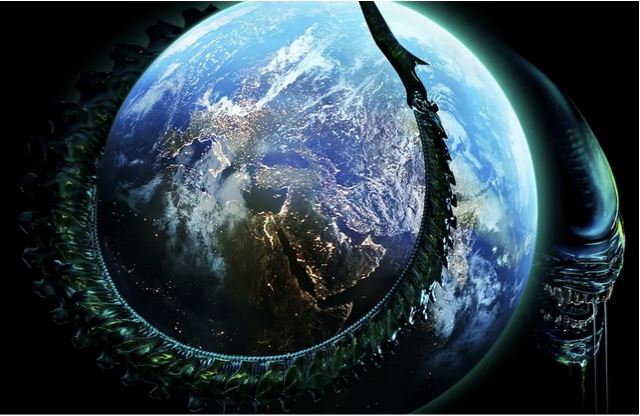 This a metaphor of some kind, probably saying that rich people are aliens and have taken over the world. Oh wait, it’s not. It’s just a literal Alien superimposed over a scaled back Earth. Or perhaps the Alien is planetary size and to scale. These are valid interpretations with how poorly the symbolism and themes are presented during the show.
THE GOOD
The show does present an excellent, faithful aesthetic set design when compared to the original film.
 Impeccable. They even used the same CRT terminal monitors for the show as well.
Well, let’s move onto the bad.
THE BAD
The films and shows I mentioned in the foreword are of course ones I enjoy. They all share equal space in my heart as well written stories. However, they do all share some commonalities. Mostly, they are what can be widely considered intellectually engaging to a certain degree and allows the viewer to arrive at their own conclusions.
Alien: Earth, doesn’t do that. At all.
It just… Tells you what you should think and feel.
The most egregious example I can think of is showcasing the brother and sister relationship when the two characters were younger that was shown explicitly in the first ten minutes of the episode. Well, as a director who knows better than the audience, how about I superimpose that exact scene about 15 minutes later to suggest that the audience wasn’t paying attention to what was happening on screen at the beginning of the episode? Or at the very least, as a director of course, suggest the audience has such room-temperature IQ that they needed some intellectual assistance to make the conclusion that the two characters knew each other. This indeed, good audience member, should make you feel emotions! Well done, you have progressed to episode 3.
There are also simple shoe-ins that don’t make sense canonically, aesthetically or thematically. It seems that the director simply decided that putting Stinkfist at the end of an episode was the best way to wrap up a narrative.
Yeah, so anyway, teh Alien shows up and Alien’s everywhere - then… TOOL starts playing.
 'I don’t associate with the Xenomorph, you know. A crass pariah, indeed.' - Stinkfist guy, 2015
Canonically, the Xenomorph should inspire dread and of course the best part of the Alien franchise, tension. I never felt tense during my viewings of the show. I never wondered where the Alien was at any point in time nor was I surprised when it did show up. If it did show up, everyone would almost instantly die (mind you, that is quite aligned to what the Xenomorph should be like, so I suppose I’ll forgive this one). Then, TOOL would play.
This good tension isn’t even limited to the medium of film and television. Alien: Isolation (2014) was the absolute pinnacle of how the Xenomorph should be interpreted by the audience. It should scare the ever living shit out of you and you shouldn’t be able to fully comprehend its movements and strategies. The developers of the game even designed their own pathing algorithm for the Xenomorph relative to where the player is in the map alongside the actions of the player which is so fine-tuned that many use it as an academic study because it’s so sophisticated. It even has a metric in it for optimization called ‘The Tension Budget’ with input parameters based on what I just described. The developers obviously cared about the series, and it shows. You can feel the effort oozing through every crevice of the game.
There was such rich, easy-to-adapt source material to work from. As an example of an Alien entry that I did enjoy was Alien: Romulus. That made me feel tense. I felt bad for the characters who were felled by the Xenomorph and there were so many amazing scenes where I was on the edge of my seat. Sneaking through a dark hallway filled with facehuggers - amazing. Floating through zero G avoiding acidic Xenomorph fluid - awesome and kind of science-ey showcasing fluid mechanics in low-gravity environments. Gravity purging the ship to keep it in orbit - such a cool detail!
Side note: In the first episode of Alien: Earth the ship that crash lands still has all of its science tooling and equipment sitting neatly on the tables. Good work.
What did Alien: Earth get? Boy Kavalier. I literally just called him Boy Genius in my head because every character in this show seemed to want to gargle his ballsack for some reason. There was a good opportunity to make a complicated, nuanced character who just so happened to be a young genius that could have perhaps focussed on his isolation and ruthlessness. Making a villain understood and somewhat likable is infinitely better than what you did. Instead, you wrote him as a self-absorbed child with the machinations and political capability to match - you know, to make sure the audience could keep up with his genius stratagems of standing in-front of active Xenomorph eggs.
I am disappointed that other interpretations of the Alien franchise have absolutely nailed all the thematic and likable elements of the series so well that the hand-craftedness of those entries feels different to Alien: Earth - you can feel the love of the series through the screen. It is clear that this entry is lazy despite its veneer of visual aesthetic alignment to the series.
S-M-R-T
So, how does the above relate to intellectual failings in media as a whole? Well, I suppose this series is one of many recent releases identified as ‘second-screen’ content. Netflix has indicated that they would encourage you to behave in ways where viewers are expected to be not actively participating in the thing they are consuming.
The things being made are expected to be second-rate and assume that the viewer is either incapable of following along for a multitude of reasons and requires constant and insultingly obvious reminders that there is a narrative to follow.
These capitalistic conglomerates are trying to implicitly plant the idea that thinking is bad for you, you should just consume what is presented and be happy about it. Afterall, it’s not that deep, man.
Revisionist history such as that presented in the Chinese Cultural Revolution of the 60s prevented people from going to school or university in order to keep capitalism at bay. Albert Einstein was a capitalist imperialist, afterall, and it’s bad to think about physics in relativistic terms
Mid-sentence recommendation for reading 3-Body Problem by Cixin Liu (2006), just by the by.
Another historical example could include Medieval peasantry where it was difficult for the average peasant to get an education of any kind, instead they were required to tend to the fields and reap the harvest to keep the kingdom running smoothly with the upper class closely guarding the field of education but allowing all into the field of wheat instead.
Point is - these were acts that thwarted attempts at engaging intellectually with something - whether that be art, science, literature, film and television. Pair this with the ability to generate massive volumes of content via AI and the enormous wealth divide between the people who design and implement these technologies, it isn’t farfetched to see a world where there are no intellectually stimulating things to see or do, just slop to consume, en-masse.
And maybe, a reminder that the main character has a sister that we told you about 15 minutes ago in case you forgot already you dumb IDIOT.